
Bhooshan Thakar
General Manager, InfoScale
The New PHP2Shell Operational Reality: You Can't Patch Your Way to Operational Resilience
What happens when the software you trust becomes the threat?
Two critical vulnerabilities in PHP with a 9.2 severity score means the potential for unauthenticated attackers to execute code inside one of the world's most widely deployed application runtimes. The newly disclosed vulnerabilities, CVE-2026-109618 and CVE-2026-109619, are another reminder of how quickly the foundation of enterprise operations can become a source of risk. PHP is the operational wakeup call we are all realizing is the new normal.
The problem is enterprises have spent decades learning how to protect applications and data, yet remain dangerously dependent on the assumption that the software underneath them will keep working. This assumption is now failing. The consequences extend beyond a security incident because the applications the business depends on stop processing transactions, data services become unavailable, infrastructure dependencies fail, and operations grind to a halt. Suddenly, the question facing the CIO wasn’t how quickly a vulnerability can be patched.
It's whether the business can keep running while the vulnerability is being addressed. That is the industry wide operational resilience gap and it's time we all closed it.
The PHP2Shell Wake-Up Call That Security Is Not the Same As Continuity
On October 21, 2026, two critical vulnerabilities were disclosed in PHP's core request-handling mechanisms. Unlike vulnerabilities introduced through application code or third-party plugins, these flaws exist within the runtime itself. CVE-2026-109618 involves memory corruption during out-of-memory request handling. CVE-2026-109619 involves stale memory state that can be reused after an interrupted cleanup operation. Both create conditions under which an unauthenticated attacker may achieve remote code execution in affected configurations.
An organization can follow secure coding practices, maintain its dependencies, and enforce application-layer security controls, and still find itself exposed by a vulnerability beneath the application. The operational response next steps are clear: identify affected systems, deploy vendor fixes, and investigate potential compromise. But for enterprise technology leaders, that response creates a whole other problem at scale. What happens to the business while thousands of interconnected systems are being patched?
The textbook remediation instruction is trivial: upgrade to fixed runtime releases (PHP 8.2.35+, 8.3.36+, 8.4.27+, 8.5.12+). At enterprise scale, this directive clashes with reality:
- The Legacy Long-Tail: EOL branches (such as PHP 8.1 and earlier) lack official upstream vendor patches. Mission-critical ERP portals, core transactional systems, and legacy e-commerce hubs frequently depend on legacy language behavior where an abrupt engine upgrade introduces fatal regressions.
- The Fragility of Emergency Patching: Pushing urgent, out-of-band runtime updates across sprawling node fleets invites catastrophic application failure, broken database drivers, dropped customer sessions, and unplanned revenue loss.
- The Shadow Runtime Footprint: Enterprise vulnerability management scans identify front-end applications, but routinely miss embedded PHP runtimes bundled inside operational toolsets, network management dashboards, and containerized third-party appliances.
If enterprise operational continuity hinges on achieving 100% patch velocity across every host before an exploit executes, your business is perpetually exposed. Consider a mission-critical application supporting financial transactions, healthcare operations, manufacturing, or digital commerce. An emergency runtime update may require restarting application processes, validating database connectors, coordinating infrastructure dependencies, and ensuring the new runtime behaves correctly under production workloads.
If you delay the patch the organization remains exposed.If you rush the deployment without adequate testing, the organization risks creating the very outage it is trying to prevent. The actions required to protect the business can themselves put business continuity at risk. The answer must be to stop making uninterrupted operations entirely dependent on perfect patching.
The Missing Layer in Enterprise Cybersecurity: Protecting the Operational State
Most enterprise architectures are built around three fundamental investments, cybersecurity protects against threats, backup preserves recoverable copies of data, and disaster recovery restores systems after an outage. While each is essential, none of these functions independently guarantees that critical business operations can continue through disruption because the business doesn't run on data alone. It runs on the operational state.
The operational state is the live, continuously changing relationship between primary data, applications, infrastructure, data services, and the dependencies that make business operations possible. Think about what happens when a customer completes a financial transaction.
The application processes the request. Data services coordinate reads and writes. Storage preserves the transaction. Infrastructure resources keep the service available. Application dependencies determine what happens next. All of these elements must remain aligned. If an application fails, the data may still exist, but the business service may be unavailable. If infrastructure fails, the application may be healthy, but unable to access its data. If primary data is corrupted, restarting the application won't restore a trustworthy operational environment.
Protecting individual components is not the same as protecting the operational state, and recovering data is not the same as recovering the business. This is why we believe the next evolution of enterprise resilience must happen at runtime, where applications, infrastructure, and primary data come together.
Introducing Autonomous Operational Resilience
At InfoScale, we're advancing a different approach to enterprise resilience so IT can protect the operational state so the business can keep running during attacks and disruptions.
InfoScale's autonomous operational resilience platform brings together AI-powered anomaly detection, primary data protection, application-aware orchestration, infrastructure resilience, and automated recovery. Rather than treating data protection, infrastructure availability, and application recovery as disconnected disciplines, InfoScale coordinates the elements required to sustain critical operations. The platform follows four interconnected principles:
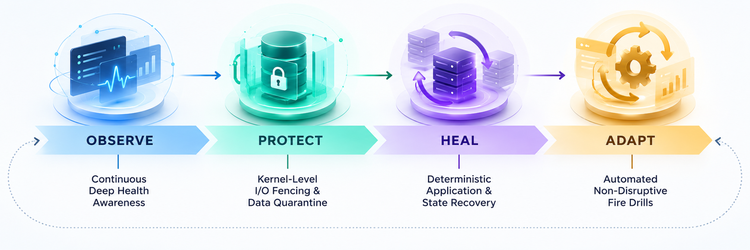
Together, they create a runtime resilience architecture designed to recognize abnormal behavior, preserve trusted operational states, respond to failures, and continuously strengthen recovery readiness.
1. OBSERVE: Know What Normal Looks Like. Detect What Doesn't.
Traditional monitoring answers a relatively simple question: Is the system running? But a system can be running and still be in trouble. For example, an application can remain online while its data access patterns change dramatically or a storage system can appear healthy while abnormal write activity accelerates. Meanwhile, infrastructure can continue responding to health checks even as underlying operational risk increases. By the time a conventional availability alert fires, the business may already be experiencing disruption.
The next generation of resilience needs to understand behavior, not just availability.
InfoScale combines application-aware resource monitoring with AI-powered anomaly detection at the data layer. Its machine learning capabilities learn patterns in monitored file system activity, including read, write, and rename behavior, as well as changes in data entropy to establish behavioral baselines and easily identify deviations that indicate abnormal activity or emerging threats to data integrity.
Instead of relying exclusively on predefined thresholds, the platform can identify activity that deviates from established patterns so when a sudden surge in writes, unusual sequence of file modifications, or unexpected changes in data entropy occur, operations teams can investigate before they become more extensive operational problems. Because this intelligence operates at the data layer, it adds a critical perspective to application and infrastructure monitoring. It does not replace endpoint security or identify every exploit. It provides an additional layer of operational intelligence where abnormal behavior can directly threaten business data.
The outcome: Earlier awareness of abnormal data activity and critical service failures, helping teams respond before operational impact escalates.
2. PROTECT: Preserve the Operational State, Not Just a Copy of the Data
Here's the problem with traditional recovery thinking. A backup can tell you what your data looked like at a particular moment, but can it tell you how that data aligned with the applications, infrastructure, and services required to run the business? Can it help restore those elements together? This is where operational state protection changes the architecture. InfoScale's approach centers on protecting primary data in alignment with the application, infrastructure, and service context required for operational recovery. Through operational state checkpoints, the platform is designed to preserve a consistent recovery reference across these interconnected elements. These checkpoints are positioned as encrypted and immutable, providing a protected state from which supported workloads can be recovered.
This isn't simply another backup copy. It's a protected operational state designed around continuity.
Traditional backup is primarily concerned with preserving data for later restoration. Operational state protection is concerned with preserving the consistency and recoverability of the systems that make data operationally useful. InfoScale also brings infrastructure-level safeguards into this architecture.
For shared-storage clusters, I/O fencing helps protect against data corruption caused by split-brain conditions and unsafe concurrent storage access. Storage management and replication capabilities further support data availability and consistency across supported resilience configurations. These controls complement security-driven isolation, rather than replacing it. Together, they help organizations protect primary data and maintain a consistent foundation for recovery when applications or infrastructure fail.
The outcome: Protected primary data aligned with critical operational dependencies, reducing the risk that a localized failure becomes a prolonged business disruption.
3. HEAL: Recover the Business, Not Just the Server
When a critical service fails, restarting a server is rarely enough. Applications depend on storage. Storage depends on infrastructure. Services depend on other services, and the order in which those resources recover matters. A database that starts before its required storage is available may fail and an application that starts before its database is ready may remain unusable. Which is exactly why recovery must be application-aware and coordinated.
InfoScale uses policy-driven orchestration to automate recovery across configured application services, infrastructure resources, and storage dependencies. When supported failure conditions occur, InfoScale can initiate service restarts, coordinate failover to healthy nodes, and bring dependent resources online in the appropriate sequence. With InfoScale Cluster Server and Cluster File System, organizations can design highly available environments that maintain coordinated access to primary data as workloads transition between infrastructure resources. And when a protected operational state checkpoint is required for recovery, the objective is to restore a consistent, functioning environment—not simply bring disconnected components back online.
This is the difference between infrastructure recovery and operational resilience. Infrastructure recovery asks whether a server is available. Operational resilience asks whether the business service is functioning with the data, infrastructure, and dependencies it needs. For appropriately designed workloads, InfoScale supports zero-data-loss and near-zero-downtime resilience objectives, helping reduce recovery time and manual intervention. The goal is not to promise that every attack can be healed automatically. It is to automate the operational response to supported failures so the business is not waiting for engineers to manually reconstruct critical services.
The outcome: Faster, coordinated recovery of applications, primary data, and infrastructure that minimizes the business impact of disruption.
4. ADAPT: Make Resilience Continuous, Not an Annual Exercise
Most organizations have a disaster recovery plan. Far fewer know with confidence that it will work when they need it and the pace of modern enterprise change makes this increasingly difficult. Applications are updated. Infrastructure is reconfigured. Data grows. Dependencies change. New vulnerabilities emerge. A recovery procedure validated six months ago may no longer reflect the environment operating today. Resilience cannot remain a static document in a dynamic world.
InfoScale supports non-disruptive Fire Drill capabilities that allow organizations to validate supported high-availability and disaster recovery configurations without interrupting production. Using recovery environments and supported data replication architectures, teams can test application startup, service dependencies, storage accessibility, and recovery orchestration. This gives engineering teams a practical way to identify gaps before an actual disruption. It also helps organizations approach infrastructure maintenance and runtime upgrades with greater confidence. Fire Drill is not a substitute for comprehensive patch regression testing. But validating recovery readiness is a critical part of reducing the operational risk associated with change. The objective is to move from hoping recovery will work to repeatedly demonstrating that critical recovery procedures can execute as intended.
The outcome: More predictable recovery, stronger operational readiness, and continuous improvement of resilience across changing enterprise environments.
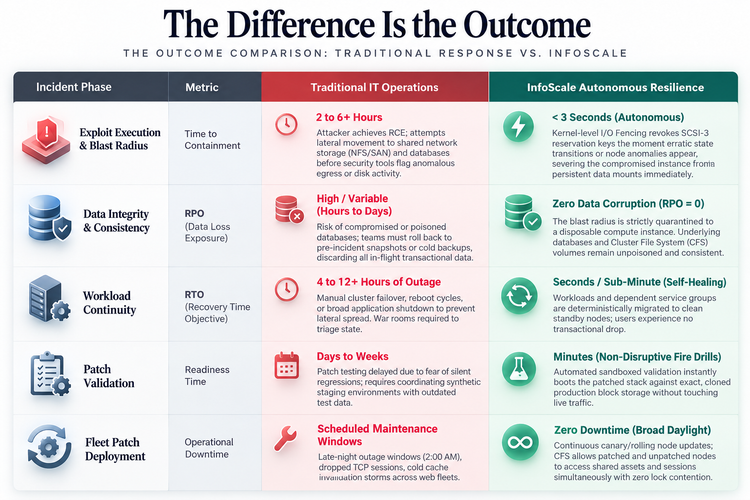
From Reactive Recovery to Continuous Operations
For years, the enterprise resilience conversation has focused on two metrics: Recovery Point Objective (RPO): How much data can we afford to lose? Recovery Time Objective (RTO): How long can we afford to be down? Both remain important, but they are not the complete measure of resilience.
Why should every infrastructure or software failure become a business outage in the first place?
An enterprise designed for continuous operations approaches the problem differently. It understands the health of critical services and data activity. It protects primary data in alignment with the operational dependencies required for recovery. It automates supported recovery actions when infrastructure or applications fail. And it continuously validates that recovery procedures remain effective as the environment changes. That is the shift from reactive recovery to autonomous operational resilience. Not every failure can be absorbed without interruption. Not every cyberattack can be contained by infrastructure automation. And no resilience platform eliminates the need for security controls, patching, or incident response. But organizations can dramatically improve their ability to withstand disruption when data integrity, application availability, and infrastructure recovery are designed as one coordinated system.
Four Questions Every CIO and CISO Should Be Asking
PHP2Shell is a timely reason to revisit an uncomfortable question: Is your organization architected to withstand a failure in the software layer itself? Before the next critical vulnerability forces an emergency response, technology leaders should be able to answer four questions.
1. Can we recognize operational abnormalities before they become outages?
Are we relying exclusively on infrastructure health checks and security alerts, or can we identify abnormal patterns in the data and services that support critical workloads?
2. Are we protecting data, or the operational state of the business?
Can we preserve a consistent recovery reference that aligns primary data with the application, infrastructure, and service context required to restore operations?
3. Can our infrastructure recover critical services autonomously?
When a node, application process, or infrastructure dependency fails, can the environment coordinate recovery according to established policies—or does restoration depend on manual intervention?
4. Can we prove that our recovery architecture works?
Are we validating critical recovery configurations regularly, or waiting for the next incident to discover whether our dependencies and recovery procedures are still correct?
These are no longer questions for infrastructure teams alone. They are business continuity questions. Cyber resilience questions. Board-level risk questions. Because when a critical service stops operating, the business impact does not distinguish between a software defect, a cyberattack, or an infrastructure failure. It only knows that operations have stopped.
The Next Security Frontier Is Operational Continuity
PHP2Shell will not be the last vulnerability discovered in a foundational software runtime.
There will be more memory-safety flaws. More zero-days. More vulnerabilities buried in the infrastructure and software supply chains that enterprises depend on. And as AI-driven systems and autonomous agents increase the speed and complexity of enterprise operations, the operational state will become even more dynamic. The security industry will continue to innovate around prevention, detection, and response. It should. But we need to acknowledge a fundamental truth:
Even the best security architecture cannot guarantee that every attack will be stopped or every component will remain available.
That is why resilience must become an architectural capability, not simply a recovery procedure. At InfoScale, we believe the future belongs to enterprises that can continuously understand, protect, and restore the operational state of their most critical systems. Enterprises where abnormal behavior is recognized earlier. Where primary data and operational dependencies are protected together, recovery is orchestrated rather than improvised, and where operational readiness is continuously validated.
We're building the future with autonomous operational resilience so the next major vulnerability doesn’t mean inevitable downtime.
Protect the operational state. Keep the business running.
Learn more: Explore InfoScale Autonomous Operational Resilience